
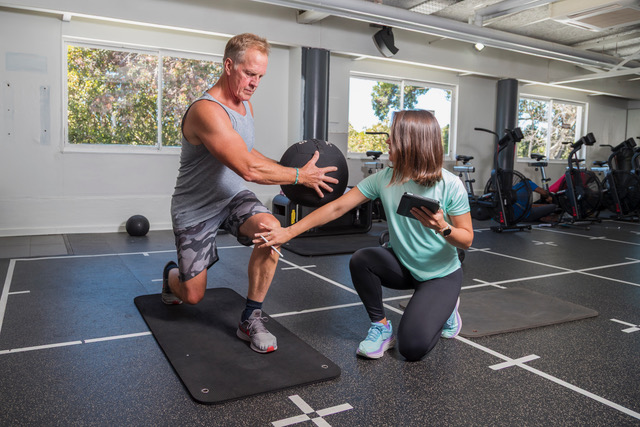
Whether you are training for an event or returning to sport, sports conditioning helps you push your performance forward in a structured and sustainable way. It is not only about lifting heavier or running faster. It is about understanding how your body moves, strengthening what supports you, and improving the quality of every step, stride, and lift.
Stacy Nellemann & Associates offers sports conditioning that focuses on smart, intentional training, supporting your goals while reducing the risk of injury. You learn how to move efficiently, how to build lasting strength, and how to use your body in ways that help you perform at your best.
What is sports conditioning?
Sports conditioning is a training approach that lays the foundation for improved performance. It improves strength, agility, stability, endurance, and movement control, which are essential elements whether you play sports competitively or stay active for enjoyment.
It focuses on strengthening the systems that support your movement, including the following:
- Muscular strength
- Joint stability
- Cardiovascular endurance
- Flexibility and mobility
- Coordination and balance
- Speed, agility, and reaction time
The goal is not only to improve your output but also to enhance the quality of your movement so you feel stronger, faster, and more capable in your sport or activity.
Who can benefit from sports conditioning?
Sports conditioning is suitable for anyone who wants to move more efficiently, perform at a higher level, or train with greater confidence. You may benefit if you experience any of the following:
- Want to improve performance in a specific sport
- Are preparing for an event or race
- Have returned to sport after injury
- Feel limited by strength, stamina, or coordination
- Want to prevent injuries and build a stronger foundation
- Train recreationally and want better overall fitness
You do not need to be an athlete to benefit. You only need the desire to build strength and move with greater ease.
What can I expect during your sessions?
Your first session begins with a movement and conditioning assessment. This helps identify strengths, imbalances, and areas that need focused attention. From there, you follow a structured training plan that adapts to your progress.
A session may include the following:
- Strength training to build power and stability
- Mobility work to improve flexibility and movement efficiency
- Cardiovascular conditioning to build endurance
- Balance and coordination drills
- Functional training related to your sport or daily activity
- Recovery-focused stretching and breathing techniques
You will be guided through every exercise, learning how to move correctly and safely challenge your body.
Why does movement quality matter for performance?
Strength alone is not enough. Your body performs best when every movement is efficient and well-coordinated. If certain muscles are weak or inactive, others compensate, and that compensation often leads to injury or a drop in performance.
When your movement patterns are assessed and corrected, you can expect the following outcomes:
- More powerful and controlled movements
- Less fatigue during activity
- Improved balance and agility
- Better alignment and posture
- Reduced risk of injury
- More confidence in your sport or training
This is where sports conditioning links naturally with other areas of your health. For example, if you have a previous injury, strengthening may be supported by orthopaedic rehabilitation to ensure your body moves safely and without risk of re-injury. If you manage a chronic condition that affects stamina or muscle function, elements of chronic disease management can help stabilise your training. Even movement challenges linked to coordination or balance may benefit from principles used in neurological assessment.
Your progress is supported from multiple angles, giving you a well-rounded approach to performance.
How long does it take to see improvement?
It varies from person to person. Some people notice changes in movement quality within a few sessions, such as improved stability or reduced fatigue during training. Others experience gradual progress over several weeks.
What remains consistent is that small, repeated efforts build powerful results. When you train with intention, your body adapts, and those adaptations support you long after the session ends.
What can I do between sessions?
Consistency is one of the most important parts of conditioning. You can support your progress by doing the following:
- Practising your home exercises
- Staying active between sessions
- Prioritising recovery and rest when needed
- Focusing on posture and movement control during daily activities
- Warming up properly before training
- Staying hydrated and fuelling your body well
These small habits reinforce your training and help you move more confidently in your sport or daily routine.
Train with purpose
Sports conditioning is about more than physical strength. It is about feeling capable, energised, and ready for the challenges your sport or lifestyle brings. With guided movement, structured training, and an approach that adapts to your needs, you can build a body that supports your goals.
At Stacy Nellemann Biokineticist & Associates, you are encouraged to move with intention, push yourself safely, and strengthen your foundation one step at a time.
If you are ready to build strength, improve your performance, and move with confidence, sports conditioning can help you achieve your goals, schedule a consultation with us today.