When your body does not move the way you expect it to, simple actions can start to feel uncertain. A change in balance, coordination, or control can affect everything from walking to posture to confidence. Neurological assessments help you understand how your body is moving, why it may have changed, and what you can do to improve it.
At Stacy Nellemann Biokineticist & Associates, each session focuses on understanding your body’s movement patterns and utilising targeted exercises to retrain them. The goal is not perfection, but progress that feels achievable and sustainable.
What is a neurological assessment?
A neurological assessment is a detailed evaluation of how your nervous system and muscles communicate during movement. It helps identify areas of weakness or dysfunction that may be affecting your ability to move with ease.
This form of assessment can be helpful for individuals living with or recovering from the following:
- Stroke or transient ischaemic attack (TIA)
- Parkinson’s disease
- Multiple sclerosis (MS)
- Head injury or concussion
- Peripheral neuropathy
- Balance or gait difficulties
- Coordination or motor control challenges
The findings guide your movement plan, focusing on what your body can do today and how it can gradually improve over time.
Why does movement change after neurological conditions?
Your nervous system acts as your body’s control centre. It sends messages from your brain to your muscles, coordinating every movement you make. When illness, injury, or degeneration interrupts that pathway, your muscles may not respond as quickly or accurately as they did before.
Over time, this can lead to the following:
- Difficulty maintaining balance
- Slower or unsteady walking
- Reduced strength or muscle tone
- Fatigue during everyday activity
- Frustration or anxiety about movement
Through guided neurological rehabilitation, these message pathways can often be saved. The brain and body learn to communicate again, finding new ways to move efficiently and safely.
What happens during a neurological assessment?
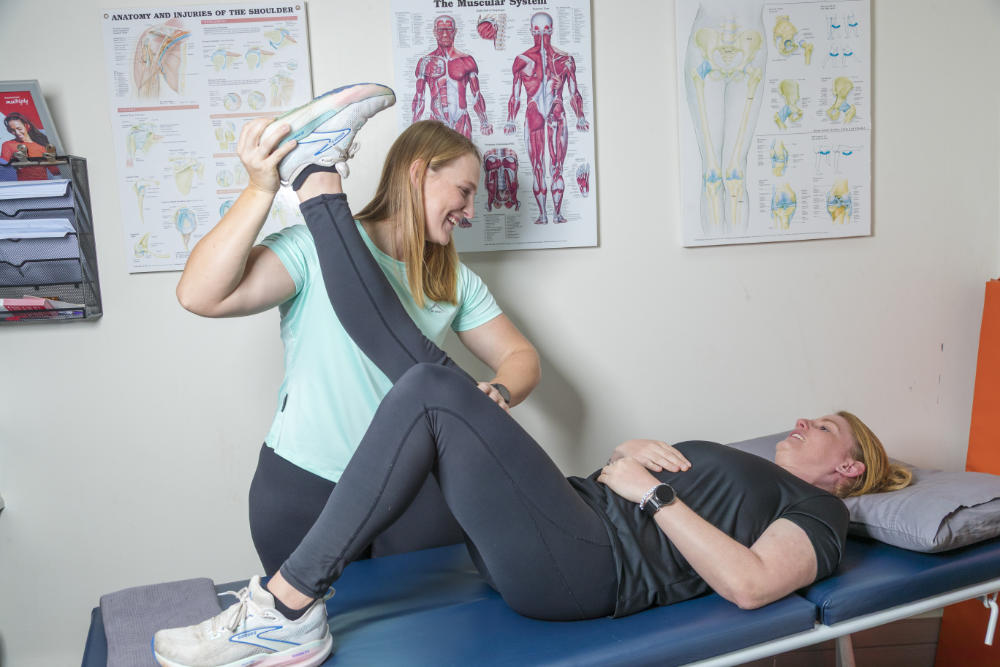
Your assessment begins with observation and testing. You will be guided through movements that help evaluate posture, coordination, balance, and muscle control. From there, a structured exercise plan is developed to target the areas that need attention.
During your sessions, you may work on one or more of the following:
- Controlled balance and stability training
- Strengthening exercises for weaker muscle groups
- Coordination and timing drills
- Gait retraining to improve walking patterns
- Functional movement practice for daily activities
- Breathing and relaxation to support focus and control
Each exercise is explained clearly, so you understand its purpose and how it helps your body relearn correct movement.
How long does neurological rehabilitation take?
Recovery is different for everyone. Some people experience steady progress within weeks, while others require longer-term support to build new movement patterns. The key is consistent effort and repetition: the more your body practises correct movement, the more your brain adapts to it.
Progress is measured not only by how far you walk or how steady you feel, but by the confidence you regain in your ability to move.
What can I do between sessions?
What happens outside the studio can be just as valuable as what happens in it. Reinforcing your new movement patterns daily helps your body retain the knowledge it has learned. You can do the following to ensure continued healing:
- Practise your assigned home exercises regularly
- Move with awareness; focus on posture, balance, and alignment
- Pace your activity to avoid fatigue
- Rest and stretch when your body needs recovery
- Stay consistent, even when progress feels slow
If your neurological condition has also led to joint stiffness or limited mobility, integrating orthopaedic rehabilitation can further support strength and flexibility. Likewise, fatigue or chronic health issues can also impact your recovery. In that case, elements of chronic disease management can be woven into your plan to stabilise endurance and overall health.
How does neurological assessment fit into your overall health journey?
Many people begin with a neurological assessment as a foundation, then progress into strength-building or endurance-based programmes such as sports conditioning, once stability improves. Each phase of your journey connects, from relearning movement to rebuilding confidence to regaining full functional ability.
This interconnected approach ensures that your body is supported from every angle, with exercises that evolve as you do.
Rebuild your connection to movement
A neurological assessment is not simply a test; it is the first step towards understanding how your body communicates, responds, and adapts. It helps you move with more awareness, confidence, and control.
Our focus is on guiding you through each phase of your recovery, one movement at a time. When you begin to reconnect your mind and body, every step forward becomes a victory. Book an appointment today.